
A reducer choice becomes expensive when it is made from ratio alone. In the planetary versus cycloidal reducers decision, both architectures can produce high torque from a compact motor, yet they distribute load, react to shock and occupy housing space in very different ways. Those differences reach beyond the gearbox. They affect bearings, shaft diameters, motor interface, housing stiffness, assembly method and the geometry you eventually send to manufacture.
For a compact actuator, indexing unit, mobile machine or small industrial drive, the useful question is not which reducer is generally better. It is which mechanism matches the duty cycle, reduction target and production constraints of the assembly.
Planetary versus cycloidal reducers at mechanism level
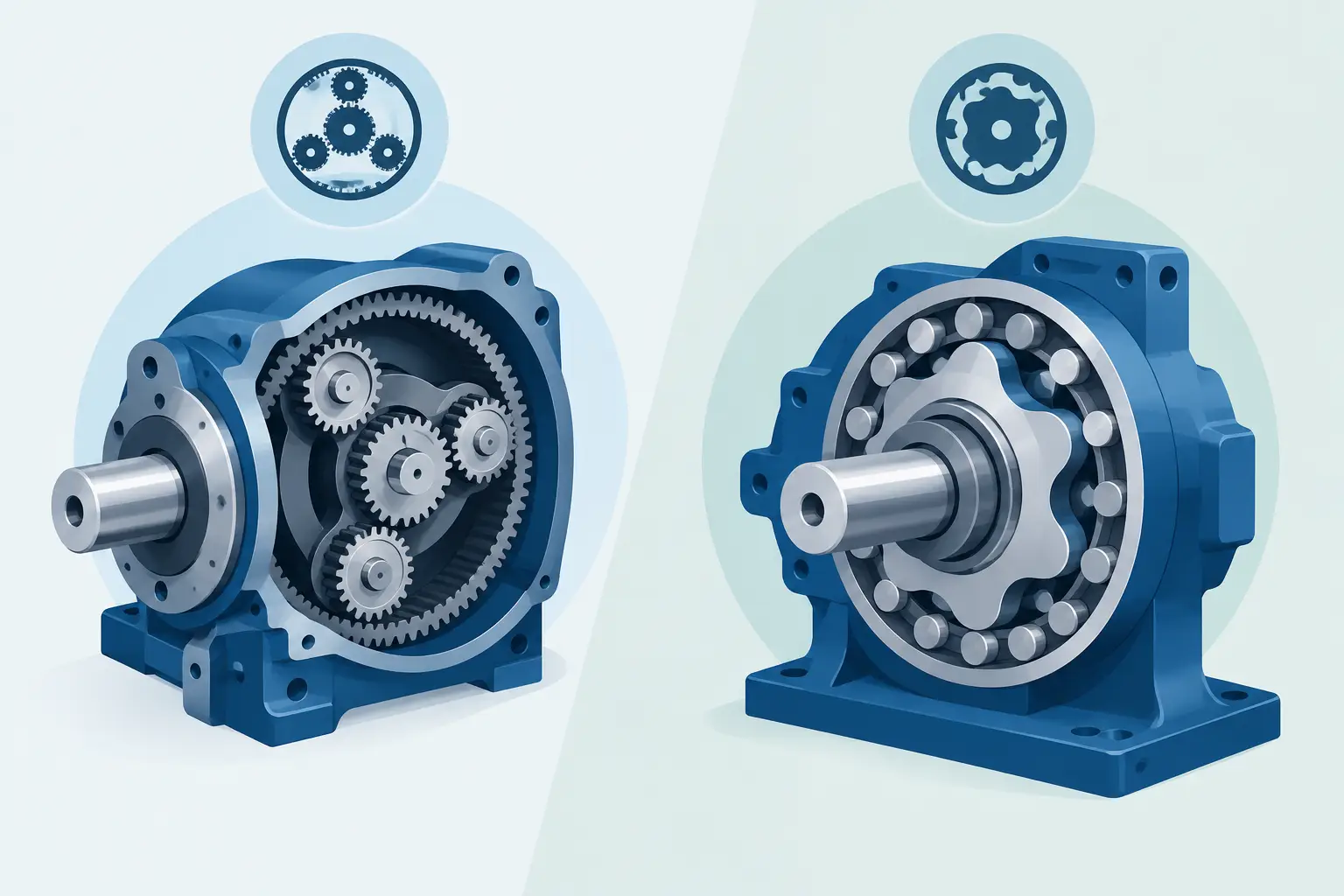
A planetary gearbox transmits power through a sun gear, several planet gears and an internal ring gear. The planets share torque across multiple tooth meshes while orbiting the sun. The output is typically carried by the planet carrier. This arrangement is concentric: motor shaft, gearbox and output shaft can sit on one centreline.
A cycloidal reducer uses an eccentric input to drive one or more cycloidal discs. The discs engage with a ring of pins or rollers, and output pins transfer the reduced motion to the output flange or shaft. The disc motion is eccentric rather than coaxial at the reduction stage, although the finished assembly can still present an in-line input and output.
That basic distinction explains much of the practical trade-off. Planetary units rely on involute gear meshes that are familiar, efficient and well suited to staged reductions. Cycloidal units use many simultaneous contacts around the disc, creating a high reduction in one main stage and a strong tolerance for transient overload.
Ratio and package size
Planetary gearboxes are often the cleaner choice at modest ratios. A single stage commonly covers roughly 3:1 to 10:1, depending on tooth counts and allowable geometry. Higher ratios are achieved by stacking stages. A two- or three-stage planetary unit can remain short enough for many servo drives, but each added stage increases axial length, part count and accumulated backlash.
Cycloidal reducers are attractive when a high reduction is required in a short axial envelope. Ratios of 30:1, 50:1 or 100:1 are natural territory for a cycloidal stage. Where a planetary design may need several gear stages to reach the same target, a cycloidal mechanism can avoid a long stack.
Radial packaging tells a different story. The cycloidal disc, pin ring, eccentric bearing and output-pin circle require diameter. A planetary unit can be especially efficient where the available envelope is narrow and coaxial, even if it needs more length. Check the actual keep-out volume, not only the gearbox diameter printed on an outline drawing.
The ratio is not the whole requirement
Start with continuous output torque, peak torque, output speed and duty cycle. Then define the allowable backlash, the external radial and axial loads at the output, and the available envelope around the motor. A 50:1 requirement with light, steady motion does not automatically justify a cycloidal reducer. Equally, a high-speed start-stop axis with repeated impacts should not be specified as a generic multi-stage planetary unit without checking its peak load path.
Torque density and shock loading
Planetary gears distribute torque through multiple planets, giving strong torque density for their size. In a properly designed stage, load sharing depends on carrier stiffness, manufacturing accuracy, bearing clearances and gear geometry. It is not automatic simply because three or four planets are present.
The tooth contacts are also sensitive to overload. A brief shock can raise tooth-root stress and contact stress sharply, especially where a compact design has limited module, face width or heat-treatment depth. Planetaries work very well in controlled servo and industrial transmission duties, but their peak rating needs to be treated as an engineering limit, not a marketing number.
Cycloidal reducers spread load over many pin contacts around the disc. This gives them a credible advantage in applications with high shock loads, frequent reversing or large inertial mismatch. They are widely used where overload survival and torsional stiffness matter as much as nominal torque.
That advantage has conditions. The eccentric bearing, pin geometry, output-pin fit and housing rigidity must all support the load path. A cycloidal disc with generous contact engagement inside a flexible housing is not a high-torque mechanism in practice. The housing, bearing seats and flange connection are part of the reducer.
Backlash, stiffness and positioning
Both types can be built for low backlash. Neither type is inherently zero-backlash once real clearances, elastic deflection, lubrication and manufacturing variation enter the assembly.
Precision planetary gearboxes can achieve low backlash through controlled tooth geometry, selective assembly and accurate carrier construction. They are common in servo axes because their rotating masses are comparatively low and their kinematics are predictable. Backlash rises with wear, temperature and stage count, so the loaded reversal behaviour matters more than an unloaded catalogue value.
Cycloidal reducers can achieve very low lost motion because many contacts engage simultaneously and clearances can be controlled through the output-pin arrangement. Their high torsional stiffness is valuable for robot joints, indexing and heavy rotary axes. However, the eccentric motion can introduce torque ripple and vibration characteristics that deserve inspection at the operating speed. A mechanism that feels precise by hand may still excite a lightweight structure at speed.
For positioning work, specify more than backlash. Define allowable lost motion at the output, torsional compliance under load, repeatability, reversal frequency and acceptable settling time. These are assembly-level requirements.
Efficiency, speed and thermal behaviour
A well-made planetary stage usually offers high efficiency, often above 90 per cent per stage under favourable load and lubrication conditions. Multi-stage losses compound, but planetary gearboxes remain a practical option for continuous running where heat rejection is limited.
Cycloidal efficiency varies more with contact design, bearing losses, preload, lubrication and speed. It can be very good, but the eccentric bearing and sliding behaviour deserve closer thermal attention than a simple spur or helical gear stage. At high input speed, churning losses and disc dynamics can become decisive.
Do not estimate thermal performance from reduction ratio alone. Calculate input power, transmission losses and heat path through the housing. Then check the actual duty cycle. A reducer that survives a short peak may still run too hot after an hour of repeated indexing.
Manufacturing and assembly implications
Planetary mechanisms use gear forms that many engineering teams already understand. Yet compact planetary geometry is less forgiving than it appears. Tooth count selection must avoid interference, planet spacing must close correctly, carrier pins need accurate location, and ring-gear manufacturing needs a realistic process route. A design that meshes visually is not necessarily manufacturable or assembleable.
Cycloidal parts place accuracy in different places. The disc profile, eccentricity, pin-ring pitch, output-pin clearance and bearing arrangement work as a system. Small profile or positional errors can alter contact distribution, backlash and running smoothness. Pin or roller selection also affects wear, lubrication and noise.
This is where a mechanism-specific workflow saves time. In GearSuite, the useful starting point is not an isolated reducer outline but connected assembly geometry: ratio-driving parameters, shafts, bearing fits, housing space and manufacturable solids inspected together. Configure the mechanism, inspect its 3D and exploded arrangement, validate constraints, then export geometry that still reflects the parts you intend to build.
Choose by duty, not by fashion
Choose a planetary reducer when you need a concentric drive, efficient operation, familiar gear manufacture and a ratio that suits one or several compact stages. It is often the practical answer for servo drives, conveyors, general automation and compact motor gearheads.
Choose a cycloidal reducer when high reduction, shock capacity, low lost motion and torsional stiffness outweigh the need for the smallest possible diameter. It is often a stronger candidate for heavy indexing, robot joints, mobile equipment and mechanisms that see repeated reversals or unpredictable load events.
The final check is physical. Put the motor interface, output bearing arrangement, housing wall thickness, fasteners and service access around the chosen reducer before declaring the architecture complete. The better reducer is the one that still fits, survives and can be made when the surrounding parts are real.